Experiment Logs:Another attempt at originality in an unfamiliar domain, which converged to unoriginality — a bitter lesson.
November 13, 2025
The Idea: Markets as Sensors, Trades as Actions
A robot operating in the real world never has complete information. It uses its sensors (vision, touch) to build a belief state—a probability distribution over all possible actual states of the world—before deciding on an action.
FigureAI’s second iteration of the product; a hivemind of robots
This struck me as a powerful analogy for algorithmic trading. A trader, like a robot, operates with incomplete information. We cannot see "the market's" true state (e.g., is it fundamentally a 'risk-on' or 'risk-off' environment?). We only have partial observations: prices, volume, and news. The challenge is to build a belief state about the market's hidden regime and act on it. We call this a Partially Observable Markov Decision Process (POMDP).
Helix 1.0: A Naive First Pass
My first project, helix-trading, was a naive but original attempt to apply this concept, leaning toward a high-frequency (HFT) interpretation. It was an exercise in building the "sensor" systems, attempting to act on raw, fast-moving observations.
While a valuable learning experience, I quickly realized two things:
- The HFT space is a game of speed and infrastructure that was not my primary interest.
- The real insight from the POMDP analogy wasn't about the next tick, but about the current context.
This led to a pivot: from high-frequency trading to mid-frequency, risk-aware portfolio management. The question evolved from "What is the next price?" to "What kind of market are we in right now?"
Helix 1.1: Detecting the Hidden State (Regime)
My second project, Dynamic_Factor_Allocation_Regime_Detection, represents this new focus. If the market's "regime" is the hidden state in our POMDP, we need an observation model to infer it.
For this, I implemented the Sparse Jump Model (SJM), a change-point detection algorithm. The goal was to feed this model price data from various factor ETFs (like Quality, Momentum, Value, etc.) and have it tell us when the underlying market behavior had fundamentally shifted—from 'Bull' to 'Bear' or vice versa.
As the chart below shows, the implementation was a success. The model clearly and automatically identifies distinct market regimes across multiple factors, providing a clean "belief state" of the market.
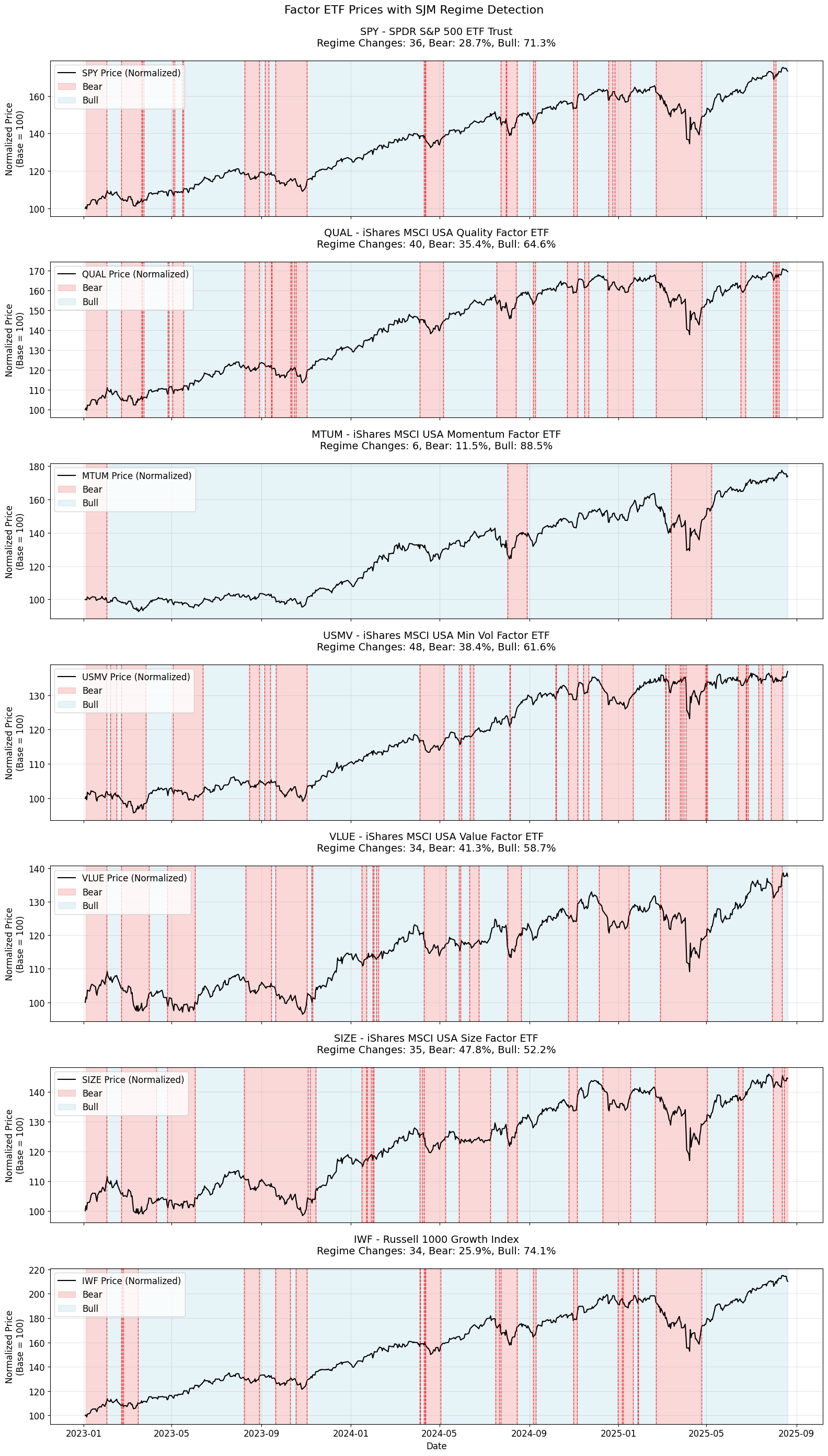
SJM successfully identifying bull and bear regimes across various factor ETFs.
This completed the observation part of the POMDP. The SJM implementation works, reliably segmenting market history into statistically distinct periods.
A Sobering Assessment: When a Model Isn't a Strategy
The next step was to build the policy—the action model. What do we do with this regime information? The "Helix 1.1" strategy was a simple, "derived" (i.e., not original) allocation model that rebalanced the portfolio based on the SJM's detected regime.
The backtest results, however, were humbling.
Backtest Summary (Helix 1.1 vs. SPY Benchmark)
| Period | Total Ret | Sharpe | Active Ret | IR | Rebalances |
|---|---|---|---|---|---|
| 2022-2025 | 69.67% | 1.41 | 8.52% | 0.55 | 113 |
| 2024-2025 | 11.10% | 0.73 | -51.08% | -2.26 | 73 |
| SPY (2024-2025) | 39.05% | 1.25 | - | - | - |
As the 2024-2025 data clearly shows, the strategy significantly underperformed its benchmark, SPY (11.10% vs. 39.05%). The consistently negative Information Ratio (IR) in recent periods confirms that the rebalancing logic not only failed to add value but actively detracted from it.
The analysis is clear: Knowing the regime is not the same as knowing how to trade it.
The SJM model is reactive; it identifies a regime change after it has already begun. A simple allocation switch based on this lagging signal is insufficient and, in this case, destructive to returns. The strategy was "whipsawed" by market changes, buying high and selling low as the regime signals flipped.
Conclusion and Next Steps
This two-project journey has been an invaluable, if humbling, lesson.
- What Worked: The POMDP framework holds. The SJM implementation (Helix 1.1) successfully models the observation step, building a coherent belief state about the hidden market regime.
- What Failed: The policy (the trading rule) was flawed. A simple, reactive switch based on the detected regime is not a profitable strategy.
This is not a dead end; instead, it's the clarification of the real problem.
The next logical step is to take this 'belief state' (the regime probability) and use it to train a smarter allocation model, perhaps using reinforcement learning or a more dynamic risk-parity framework. The helix, in essence, is still being built.